
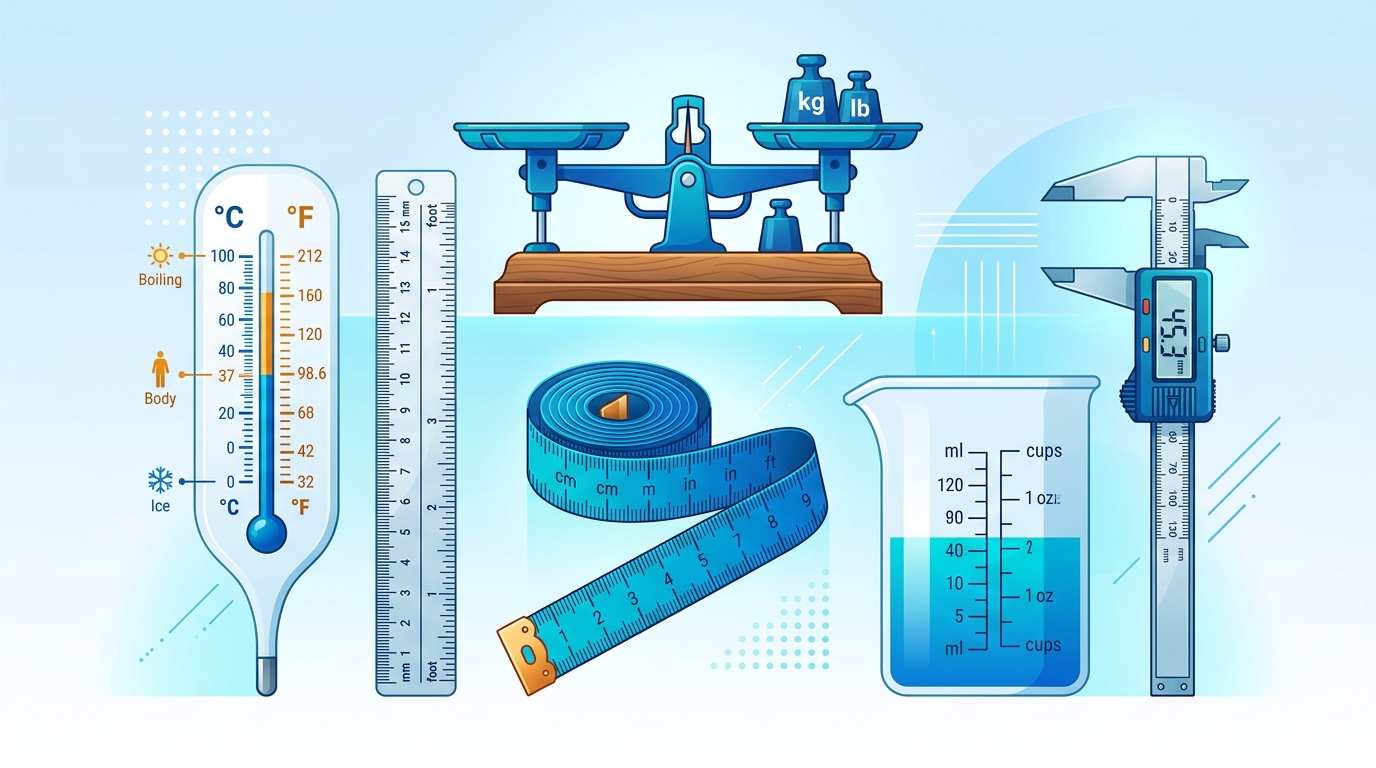
Measurement is humanity’s oldest scientific framework. From ancient Egyptian royal cubits carved into stone monuments to modern laser interferometers measuring gravitational waves, every trade, construction project, medical prescription, and culinary recipe depends on standardized measurement units.
However, our modern globalized world is divided between two major measurement traditions: the International System of Units (Metric / SI) used by science, industry, and over 95% of the world's population, and the Imperial / US Customary systems favored in the United States, the United Kingdom, and international aviation. Whether you are following a European baking recipe in cups and grams, ordering DIY lumber in inches and millimeters, or converting weather reports from Celsius to Fahrenheit on vacation, unit conversions are an unavoidable part of daily life.
What is a Unit Converter?
A unit converter is a computational tool that translates a numeric quantity expressed in one unit of measurement into an equivalent value expressed in a different unit of the same physical dimension (such as length, mass, volume, or temperature).
Under the hood, unit conversion relies on conversion factors—exact mathematical ratios that express how many units of type B equal one unit of type A. For linear quantities like distance and weight, conversion is achieved through multiplication or division. For affine quantities like temperature, conversion requires both scaling and an origin offset.
Convert Units for Free
Instantly switch between kilometers, miles, meters, feet, kilograms, pounds, Celsius, and Fahrenheit. Zero sign-up, zero downloads, and 100% private in-browser conversions.
Why Accurate Unit Conversions Matter
Failing to convert measurements accurately is not merely an academic nuisance; history is filled with catastrophic engineering, medical, and financial failures caused by simple conversion oversights:
- The NASA Mars Climate Orbiter (1999): NASA lost a $125 million spacecraft because the ground-based navigation software calculated thruster impulses in Imperial pound-force seconds (lbf·s), while the spacecraft’s onboard computer expected Metric Newton-seconds (N·s). The probe entered the Martian atmosphere too low and disintegrated.
- The "Gimli Glider" (1983): Air Canada Flight 143 ran completely out of fuel at 41,000 feet because maintenance crews calculated fuel volume using 1.77 pounds per liter instead of 0.8 kilograms per liter. The pilots remarkably glided the Boeing 767 to a safe emergency landing without engine power.
- Medical & Pharmaceutical Dosages: Liquid medications frequently require exact conversions between milliliters (mL), teaspoons (tsp), and milligrams (mg). A mix-up between a tablespoon (15 mL) and a teaspoon (5 mL) results in a dangerous 300% overdose.
How to Convert Length and Distance
Length measures one-dimensional spatial distance. The Metric system uses the meter (m) as its base unit, while the Imperial and US Customary systems use the inch (in), foot (ft), yard (yd), and mile (mi).
Core Length Conversion Factors:
- 1 kilometer (km) = 1,000 meters (m)
- 1 meter (m) = 100 centimeters (cm) = 1,000 millimeters (mm)
- 1 foot (ft) = 12 inches (in)
- 1 yard (yd) = 3 feet (ft) = 36 inches (in)
- 1 inch (in) = exactly 2.54 centimeters (cm) (25.4 mm)
- 1 mile (mi) = 5,280 feet = 1.609344 kilometers (km)
Miles to Kilometers = Miles × 1.609344
Kilometers to Miles = Kilometers ÷ 1.609344 (or × 0.621371)
Inches to Centimeters = Inches × 2.54
Feet to Meters = Feet × 0.3048
Worked Length Examples:
- Example 1 (Kilometers to Meters): Convert 5 kilometers to meters.
5 × 1,000 = 5,000 meters. - Example 2 (Miles to Kilometers): Convert a 60 mph highway speed to km/h.
60 × 1.609344 = 96.56 km/h. - Example 3 (Feet to Centimeters): Convert a 6-foot person's height to cm.
6 × 12 = 72 inches; then72 × 2.54 = 182.88 cm.
How to Convert Weight and Mass
In everyday conversation, "weight" and "mass" are used interchangeably, but in physics, they are fundamentally distinct. Mass is the total quantity of matter in an object (measured in kilograms or grams), which remains identical whether on Earth, the Moon, or in deep space. Weight is the gravitational force exerted upon that mass (measured in Newtons or pounds-force). Because terrestrial gravity is relatively uniform at sea level, consumer scales calibrate mass to Earth's gravity directly.
Core Weight & Mass Conversion Factors:
- 1 kilogram (kg) = 1,000 grams (g)
- 1 pound (lb) = exactly 0.45359237 kilograms (kg) (16 ounces)
- 1 kilogram (kg) ≈ 2.20462 pounds (lbs)
- 1 ounce (oz) ≈ 28.3495 grams (g)
- 1 metric ton (tonne) = 1,000 kilograms = 2,204.62 pounds
Pounds to Kilograms = Pounds × 0.45359237
Kilograms to Pounds = Kilograms × 2.20462
Grams to Ounces = Grams ÷ 28.3495
Worked Weight Examples:
- Example 1 (Kilograms to Grams): Convert 2.5 kilograms to grams.
2.5 × 1,000 = 2,500 grams. - Example 2 (Gym Plates): Convert a standard 45-pound Olympic barbell plate to kilograms:
45 × 0.45359237 = 20.41 kg. - Example 3 (Produce / Culinary): Convert an 8-ounce steak to grams:
8 × 28.3495 = 226.8 grams.
How to Convert Temperatures (°C, °F, and K)
Unlike length or weight, temperature scales do not share a common zero point. Water freezes at 0°C, but at 32°F. Water boils at 100°C, but at 212°F. Because 100 Celsius degrees span the same physical thermal range as 180 Fahrenheit degrees, each degree Celsius equals 1.8 degrees Fahrenheit (180/100 = 9/5).
The Three Primary Temperature Formulas:
Celsius to Fahrenheit: °F = (°C × 9/5) + 32 (or °F = (°C × 1.8) + 32)
Fahrenheit to Celsius: °C = (°F − 32) × 5/9 (or °C = (°F − 32) ÷ 1.8)
Celsius to Kelvin: K = °C + 273.15
Kelvin to Celsius: °C = K − 273.15Key Benchmark Temperature Equivalents:
- Freezing Point of Water:
0°C = 32°F = 273.15 K - Normal Human Body Temperature:
37°C = 98.6°F = 310.15 K - Comfortable Room Temperature:
25°C = 77°F = 298.15 K - Boiling Point of Water (at sea level):
100°C = 212°F = 373.15 K - The Unique Crossover Point:
−40°C = −40°F(the only point where Celsius and Fahrenheit register the exact same numerical value).
Metric vs. Imperial & US Customary Systems
Understanding the philosophical differences between the two systems makes conversion much easier:
The Metric System (SI)
Designed during the French Enlightenment, the Metric system is decimal-based (powers of 10). Prefixes tell you the magnitude instantly: kilo- (1,000), centi- (1/100), and milli- (1/1,000). Moving between millimeters, centimeters, meters, and kilometers only requires shifting decimal points.
Imperial & US Customary
Evolved historically from agricultural and trade conventions. Units use diverse bases: 12 inches in a foot, 3 feet in a yard, 1,760 yards in a mile, and 16 ounces in a pound. While intuitive for physical human estimation, calculations require fractional math rather than decimal shifting.
Comprehensive Conversion Reference Table
Keep this verified reference table handy for quick conversions across length, mass, volume, and temperature:
| Measurement Category | Starting Unit (From) | Target Unit (To) | Exact or Standard Result | Formula / Conversion Factor |
|---|---|---|---|---|
| Length | 1 kilometer (km) | Meters (m) | 1,000 m | Multiply by 1,000 |
| Length | 1 inch (in) | Centimeters (cm) | 2.54 cm | Multiply by 2.54 |
| Length | 1 foot (ft) | Inches (in) | 12 in | Multiply by 12 |
| Length | 1 mile (mi) | Kilometers (km) | 1.609344 km | Multiply by 1.609344 |
| Length | 1 meter (m) | Feet (ft) | ≈ 3.28084 ft | Divide by 0.3048 |
| Mass / Weight | 1 kilogram (kg) | Grams (g) | 1,000 g | Multiply by 1,000 |
| Mass / Weight | 1 pound (lb) | Kilograms (kg) | 0.45359237 kg | Multiply by 0.45359237 |
| Mass / Weight | 1 ounce (oz) | Grams (g) | ≈ 28.3495 g | Multiply by 28.3495 |
| Volume | 1 liter (L) | Milliliters (mL) | 1,000 mL | Multiply by 1,000 |
| Volume | 1 US fluid oz (fl oz) | Milliliters (mL) | ≈ 29.5735 mL | Multiply by 29.5735 |
| Volume | 1 UK Imperial fluid oz | Milliliters (mL) | ≈ 28.413 mL | Multiply by 28.413 |
| Temperature | 0°C | Fahrenheit (°F) | 32°F | (0 × 1.8) + 32 |
| Temperature | 100°C | Fahrenheit (°F) | 212°F | (100 × 1.8) + 32 |
| Temperature | 0°C | Kelvin (K) | 273.15 K | 0 + 273.15 |
Try FreeToolKit’s Fast Unit Converter
Instantly convert between Metric and Imperial lengths, weights, and temperatures with high numerical precision. Nothing is saved or sent to servers.
Everyday Practical Conversion Examples
International Baking & Culinary Recipes
American baking books specify oven temperatures in Fahrenheit (e.g. 350°F), while European and Asian ovens use Celsius. Converting 350°F gives (350 − 32) × 5/9 = 176.67°C ≈ 175°C to 180°C. Similarly, liquid volume ingredients measured in US cups (240 mL) require careful measuring when scaled against European metric weights.
Road Trips, Travel & Fuel Efficiency
Driving from the US into Canada or Mexico immediately switches road signs from miles per hour (mph) to kilometers per hour (km/h). A 70 mph speed limit translates to 70 × 1.609344 = 112.65 km/h (typically posted as 110 km/h).
Home DIY, Carpentry & 3D Printing
3D printers, CNC routers, and CAD software operate natively in millimeters. If you design a part intended to fit a 0.5-inch bolt, setting your CAD model to 0.5 × 25.4 = 12.7 mm ensures exact fitment without play or binding.
Common Unit Conversion Mistakes to Avoid
Fluid Ounces vs. Ounces
A fluid ounce (fl oz) measures volume (space occupied), whereas an avoirdupois ounce (oz) measures weight (mass). 8 fluid ounces of honey weigh nearly 12 ounces on a kitchen scale because honey is much denser than water.
US Gallons vs. Imperial Gallons
A British Imperial gallon is 4.546 liters, while a US gallon is only 3.785 liters. If you compare fuel economy (miles per gallon) between UK and US automotive reviews, the UK figures will appear ~20% higher solely due to the larger gallon!
Forgetting the Temperature Offset
You cannot convert temperature simply by multiplying by 1.8. You must always add 32 when converting to Fahrenheit, or subtract 32 before multiplying by 5/9 when converting to Celsius.
Premature Decimal Rounding
If chaining multiple conversions (e.g., miles to feet, then feet to meters), rounding intermediate values too early compounds calculation errors. Always maintain full precision until formatting the final result.
How FreeToolKit’s Unit Converter Works
FreeToolKit’s Unit Converter is built as a lightweight, zero-latency browser utility:
- Dimension Categories: Select whether you are converting Length, Mass, or Temperature.
- Unit Pairs: Pick your source unit and destination unit from standard drop-down selectors.
- Reactive Calculation: As you type your value into the input field, the tool computes and displays the converted value in real time.
- 100% In-Browser Privacy: Calculations happen strictly in your browser's JavaScript memory. No numbers, parameters, or conversions are uploaded to any server.
Looking for other practical everyday tools? You can calculate percentages with our Percentage Calculator, compute calendar intervals with our Date Difference Calculator, or determine your chronological age in days and months with our Age Calculator.
Conclusion & Next Steps
Whether you are calibrating 3D printer dimensions, cooking a family dinner from an imported recipe book, or pacing your travel speed abroad, accurate unit conversions remove the guesswork and keep your projects running smoothly.
Ready to convert measurements?
Use our free, instant online Unit Converter right now. No sign-up, no invasive ads, and accurate results every time.