
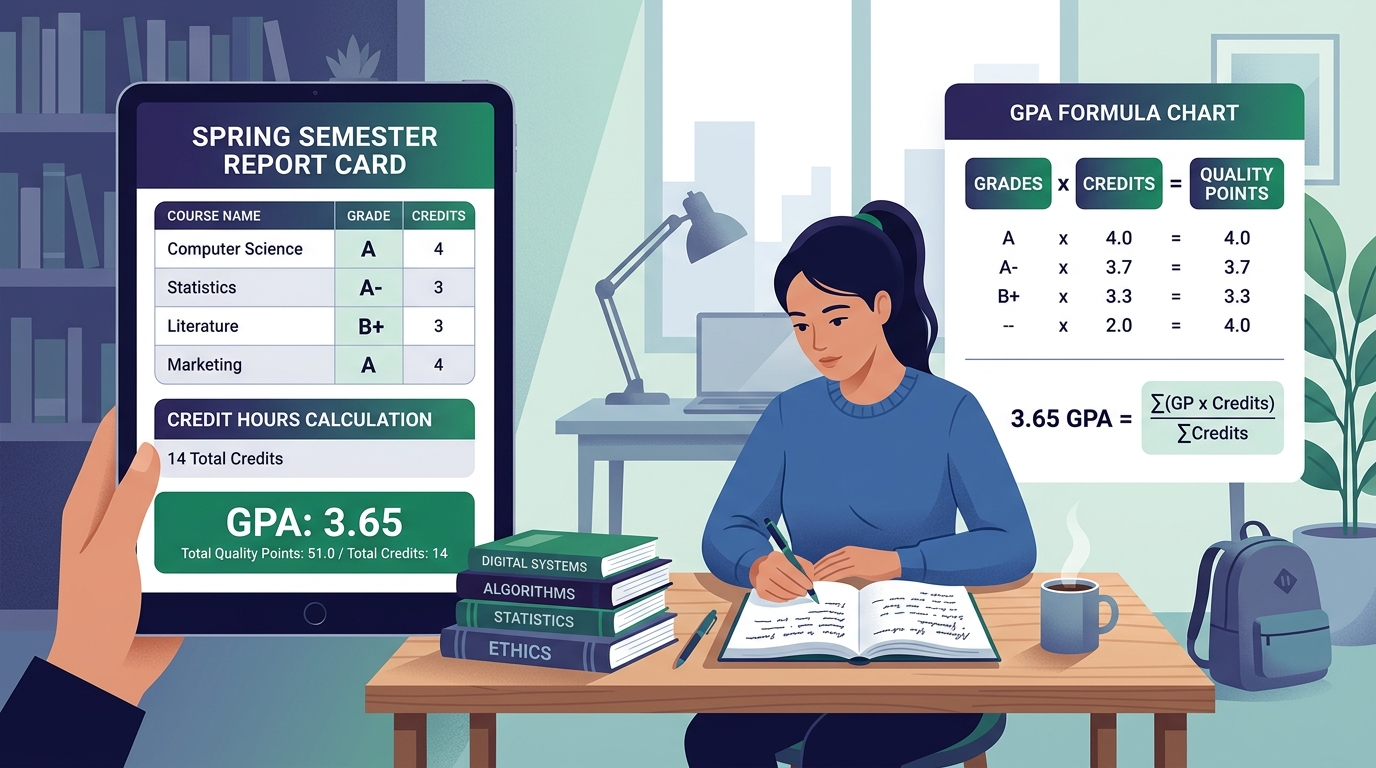
From high school college applications to university Dean’s Lists, scholarship renewals, graduate school admissions, and corporate job recruiting, your Grade Point Average (GPA) is one of the most widely referenced metrics in modern education. Yet despite its prevalence, calculating a GPA accurately often causes confusion. Many students are unsure how credit hours work, how semester GPAs roll into a cumulative average, or how to avoid misleading mathematical shortcuts. This comprehensive step-by-step guide explains exactly how to calculate your GPA manually, clarifies key grading scales, and shows you how to check your numbers instantly using FreeToolKit’s free in-browser tools.
Why Calculating Your GPA Matters
Calculating your GPA is not just an administrative task to perform when final grade reports arrive; it is an active academic planning skill. Rather than waiting passively for official end-of-term transcripts, tracking your GPA throughout the semester enables you to make informed, strategic decisions about your studies.
Keeping an accurate, proactive record of your GPA helps you:
- Protect Financial Aid and Scholarships: Many merit-based grants, athletic scholarships, and institutional fee waivers require students to maintain a strict minimum GPA (frequently 3.00, 3.25, or 3.50). Knowing your exact standing ensures you never risk sudden funding loss.
- Plan Target Grades Before Final Exams: When you know your current credit weights and grade points, you can calculate the exact grade you need in an upcoming final exam or term paper to reach your desired semester target.
- Navigate Graduation and Degree Requirements: Most academic degree programs enforce two distinct GPA thresholds: a minimum general cumulative GPA (often 2.00) and a higher major-specific GPA (often 2.50 or 2.75) for core upper-division courses.
- Prepare for Graduate and Professional School Admissions: Medical schools, law programs, MBA cohorts, and competitive master’s degrees place heavy weight on cumulative GPAs when screening thousands of applicants.
- Make Informed Course Registration Decisions: If you are on the borderline between academic honors or academic probation, understanding credit weighting helps you balance challenging 4-credit lab courses alongside standard 3-credit lectures.
Calculate Your GPA for Free
Instantly compute credit-weighted semester or cumulative GPAs on a standard 4.0 scale with FreeToolKit. Zero registration, zero fees, and 100% private.
What Is GPA?
GPA stands for Grade Point Average. It is a single, standardized numerical index that summarizes a student’s overall academic achievement across multiple courses over a given academic period.
Instead of evaluating your academic record by reading dozens of individual letter grades (such as A, B+, C) or raw percentage test scores, educational institutions convert each letter grade into numerical grade points. By multiplying these grade points by the credit value of each course and dividing by total completed credit hours, the institution arrives at a unified average that reflects both the quality of your performance and the volume of academic work completed.
While the unweighted 4.0 scale is the most common system across the United States, Canada, and many international English-medium universities, GPA systems are not universally standardized worldwide. Some institutions utilize 5.0 scales, 7.0 scales, 10.0 scales, percentage-based grading schemes, or qualitative degree classifications (such as First Class Honours in the United Kingdom).
Grading Scales: 4.0, Letter Grades, and Percentage Systems
To calculate your GPA accurately, you must first know the specific grading scale adopted by your school or university. In a standard North American unweighted 4.0 system, letter grades are mapped to grade points according to the following typical distribution:
| Letter Grade | Standard Grade Points (4.0 Scale) | Typical Percentage Range (Institutional) | Academic Description |
|---|---|---|---|
| A | 4.0 | 93% – 100% | Excellent / Outstanding |
| A− | 3.7 | 90% – 92% | Very Good |
| B+ | 3.3 | 87% – 89% | Good / Above Average |
| B | 3.0 | 83% – 86% | Competent / Average |
| B− | 2.7 | 80% – 82% | Satisfactory |
| C+ | 2.3 | 77% – 79% | Fair / Marginal |
| C | 2.0 | 73% – 76% | Passing Baseline |
| C− | 1.7 | 70% – 72% | Minimum Passing Credit |
| D+ | 1.3 | 67% – 69% | Deficient Credit |
| D | 1.0 | 60% – 66% | Barely Passing |
| F | 0.0 | Below 60% | Failure / No Credit Earned |
Grading conversions vary significantly between institutions. For instance, some schools assign an “A+” grade 4.0 points, while others assign 4.33 points. Some universities do not use plus/minus modifiers at all (awarding A = 4, B = 3, C = 2, D = 1, F = 0). Always consult your official course catalog or registrar handbook to confirm the exact values in force at your school.
Semester GPA vs. Cumulative GPA
Students frequently confuse their Semester GPA (sometimes called Term GPA) with their Cumulative GPA. While both use the exact same mathematical weighting formula, they encompass fundamentally different scopes of your academic record:
Measures your academic performance solely for courses completed during a single individual semester or quarter (e.g., Fall 2026). It serves as a localized snapshot often used to determine term honors such as the Dean’s List or immediate term probation warnings.
Measures your comprehensive performance across your entire academic career at the institution, combining every completed graded course across all completed semesters. Your Cumulative GPA appears on your official graduation diploma and final transcript.
Illustrative Difference: Why They Can Diverge
Consider a sophomore who had a difficult first year, completing 30 credits with a 2.50 Cumulative GPA. In their third semester (Fall), they adopt better study habits and earn an exceptional 3.80 Semester GPA across 15 credits.
While their Semester GPA for that specific term is 3.80, their new Cumulative GPA does not jump to 3.80; instead, the 15 credits of 3.80 blend into the existing 30 credits of 2.50, resulting in an updated Cumulative GPA of approximately 2.93. The two metrics tell complementary stories: the Semester GPA reflects immediate upward momentum, while the Cumulative GPA reflects overall long-term standing.
Note: Official institutional policies and registrar transcripts determine which specific courses count toward each average. Transfer credits, developmental courses, and re-taken subjects may be treated differently depending on institutional regulations.
How to Calculate GPA Manually (Step-by-Step)
Calculating a credit-weighted GPA manually is a straightforward eight-step process. You do not need advanced mathematics—just basic multiplication, addition, and division.
- Step 1: List all courses included in the calculation. Write down every graded course you completed during the term or academic period. Exclude non-credit classes or courses graded on a pass/fail basis.
- Step 2: Find the letter grade earned in each course. Record your official final letter grade for each course (e.g., A, B+, B, C).
- Step 3: Convert each letter grade to grade points using your school’s scale. Look up the numerical grade point value corresponding to each letter grade (e.g., A = 4.0, A− = 3.7, B+ = 3.3).
- Step 4: Identify the credit hours assigned to each course. Note the credit weighting for each course from your registration schedule (e.g., 3 credits for a standard lecture, 4 credits for a laboratory course, 1 credit for a physical education elective).
- Step 5: Multiply each course’s grade points by its credit hours. This calculation gives you the quality points (also called honor points) earned in that specific course:Quality Points = Grade Points × Credit Hours
- Step 6: Add up the quality points from all courses. Sum all the individual quality point totals calculated in Step 5 to find your total quality points.
- Step 7: Add up all the included credit hours. Sum the credit values of all courses included in the calculation to find your total GPA credit hours.
- Step 8: Divide total quality points by total included credit hours. Perform the final division to compute your final GPA:GPA = Total Quality Points ÷ Total Included Credit Hours
In mathematical summation notation, the credit-weighted GPA formula is expressed as:
This weighted formula guarantees that a course carrying 4 credit hours contributes twice as much to your final average as a course carrying only 2 credit hours.
Worked Example: Calculate a Credit-Weighted GPA
Let us walk through a complete, verified example using a typical university semester consisting of four courses with different credit values.
Suppose a student completes the following hypothetical semester under a standard 4.0 grading scale:
- Mathematics: 3 credit hours, Grade A (4.0 points)
- English: 3 credit hours, Grade B (3.0 points)
- Biology: 4 credit hours, Grade A− (3.7 points)
- History: 2 credit hours, Grade B+ (3.3 points)
| Course | Grade Earned | Grade Points | Credit Hours | Quality Points Calculation | Quality Points |
|---|---|---|---|---|---|
| Mathematics | A | 4.0 | 3 | 4.0 × 3 | 12.0 |
| English | B | 3.0 | 3 | 3.0 × 3 | 9.0 |
| Biology | A− | 3.7 | 4 | 3.7 × 4 | 14.8 |
| History | B+ | 3.3 | 2 | 3.3 × 2 | 6.6 |
| Totals | — | — | 12 Credit Hours | — | 42.4 Quality Points |
Performing the Final Division
Now apply Step 8 of the manual calculation formula:
Carrying out the long division:
Rounded to the standard two decimal places, this student’s semester GPA is 3.53.
Verification Note: 12.0 + 9.0 + 14.8 + 6.6 = 42.4 quality points. 3 + 3 + 4 + 2 = 12 credit hours. 42.4 ÷ 12 = 3.5333... → exactly 3.53. This is an entirely hypothetical academic scenario; actual letter-to-point conversions depend on your institution.
How to Calculate GPA Without Credit Hours (Equal Weight)
In certain educational settings—such as some high schools or institutions where every single course is considered to have identical academic value—courses do not carry differing credit weights.
When every course carries the exact same weight, you can calculate your GPA using a simple arithmetic average of the grade points:
Worked Equal-Weight Example
Suppose a high school student takes four equally weighted courses and earns grades of A (4.0), A− (3.7), B+ (3.3), and B (3.0):
- Sum the grade points: 4.0 + 3.7 + 3.3 + 3.0 = 14.0
- Count the number of courses: 4 courses
- Divide the sum by the count: 14.0 ÷ 4 = 3.50
The unweighted GPA is exactly 3.50.
Never use the simple unweighted average if your courses carry different credit hours (such as 4 credits for Science and 1 credit for Health). Doing so distorts your result because it falsely assumes all classes have equal mathematical influence.
How to Calculate Semester GPA
Your Semester GPA represents the weighted average of all courses taken within a single, discrete academic term (such as Fall, Spring, or Summer term).
To calculate your Semester GPA accurately, ensure you include only eligible courses assigned official letter grades for that term.
Special Grade Designations & Institutional Policies
Not every entry on a student’s semester course schedule contributes to their GPA. Colleges and universities handle special grade marks according to explicit institutional bylaws:
- Pass / Fail (or Satisfactory / Unsatisfactory): In most institutions, passing grades (P or S) confer earned credit toward degree requirements but contribute 0.0 quality points and are excluded from the GPA denominator. However, in some systems, a failing grade in a pass/fail course (F or U) is calculated as a 0.0 in the GPA.
- Withdrawals (W): When a student withdraws from a course before the institution’s official deadline, a “W” typically appears on the transcript. Withdrawals carry zero credit and zero grade points, having no impact on the GPA calculation.
- Incomplete Grades (I): An Incomplete is an interim placeholder granted when unforeseen circumstances prevent course completion. While active, an “I” is usually excluded from the GPA. However, if uncompleted by the deadline, many universities automatically convert an “I” into an “F”.
- Repeated Courses (Grade Forgiveness / Replacement): When retaking a previously failed or low-graded course, some institutions replace the original grade in the cumulative GPA calculation, while others average both attempts together.
Because these regulations differ across schools, always check your institution’s academic catalog rather than assuming a universal standard.
How to Calculate Cumulative GPA Across Semesters
One of the most widespread mathematical errors students make is attempting to calculate their Cumulative GPA by taking the simple average of their individual semester GPAs.
Do not simply add your semester GPAs and divide by the number of semesters! A simple average is only mathematically valid if every single semester had the exact same number of graded credit hours. If one semester had 15 credits and another had 12 credits, the 15-credit semester must carry greater mathematical weight.
The True Cumulative GPA Formula
Hypothetical Two-Semester Comparison
Let us illustrate why credit weighting matters when combining multiple academic terms:
- Semester 1 (Fall): Student completes 15 credit hours with a Semester GPA of 3.60.Quality Points = 15 credits × 3.60 = 54.0 quality points
- Semester 2 (Spring): Student completes 12 credit hours with a Semester GPA of 3.00.Quality Points = 12 credits × 3.00 = 36.0 quality points
This ignores the fact that the student completed 3 more credits in the stronger Fall semester.
Proper credit weighting awards the student their true 3.33 Cumulative GPA—0.03 higher than the naive average!
What Is a Good GPA? Benchmarks & Context
The question “What is a good GPA?” cannot be answered with a single universal number. What represents an outstanding achievement in an intensely graded engineering or pre-med curriculum might differ from benchmarks in other disciplines. Furthermore, expectations vary drastically across high schools, universities, countries, and prospective employers.
On a standard unweighted 4.0 scale, educators generally observe the following illustrative benchmarks:
Qualifies for highest academic honors, competitive institutional scholarships, and top-tier graduate admissions (medical, law, elite PhD cohorts).
Typically satisfies the threshold for Dean’s List recognition, departmental honors, and most graduate school entry requirements.
A solid, respected academic performance. Meets the prerequisite cutoffs for most corporate internships and standard master’s programs.
A 2.00 is generally the minimum threshold required to maintain “Good Academic Standing” and graduate from most undergraduate degree programs.
Never assume that achieving a specific GPA guarantees admission into a program, secures an employment offer, or wins a scholarship. Modern admissions committees conduct holistic evaluations, reviewing personal statements, standardized test scores, extracurricular leadership, research publications, and letters of recommendation alongside numeric grades.
GPA vs. Percentage: Differences and Conversions
Students transferring between international education systems frequently ask how to convert percentage marks into a 4.0 GPA. While both metrics quantify academic performance, they operate under completely distinct frameworks:
- Percentages: Measure the exact proportion of marks earned out of a possible 100 on exams, assignments, and continuous assessments (e.g., 85/100 = 85%).
- GPA: Compresses percentage ranges into standardized discrete grade points (such as 4.0, 3.7, 3.3) and weights them by credit hours.
Is There a Universal GPA-to-Percentage Formula?
No. There is no universally valid conversion formula from GPA to percentage. Online formulas that tell you to “simply divide your percentage by 20” or “multiply your GPA by 25” are mathematically misleading because grading curves and point thresholds differ across universities.
For instance, in the United Kingdom or India, scoring 70% in an undergraduate degree frequently qualifies for First Class Honours (an outstanding result equivalent to an A or 3.7–4.0 GPA). In contrast, in a standard US university, a 70% is a “C−” worth only 1.70 grade points.
If you need to calculate raw percentages for your individual test scores before converting them to grade points, try our free Percentage Calculator.
Common GPA Calculation Mistakes to Avoid
Even small arithmetic errors or misunderstandings can result in inaccurate GPA estimates. Keep an eye out for these eight common pitfalls:
Treating a 4-credit organic chemistry lecture the same as a 1-credit seminar skews your average. Always multiply grade points by credit hours first.
Adding semester GPAs and dividing by the number of semesters produces mathematical errors whenever semester credit loads differ.
Assuming your school awards 4.33 for an A+ when your institution caps grades at 4.00, or using 3.0 for a B+ instead of 3.3, invalidates your estimate.
Believing that an “A” (4.0) and a “C” (2.0) simply equal a “B” (3.0) fails when the courses carry different credit values.
Round only the final GPA quotient at the very end. Rounding intermediate quality points introduces compounding rounding errors.
Including audited courses, pass/fail credits, or withdrawn subjects into your GPA denominator artificially depresses your average.
Assuming a repeated course automatically erases the previous F from your cumulative record without verifying whether your school uses replacement or averaging.
Relying on generic internet percentage-to-GPA conversion formulas rather than checking the official conversion table published in your academic syllabus.
How to Use FreeToolKit’s GPA Calculator
Instead of performing long division by hand or building a manual spreadsheet, you can calculate your credit-weighted GPA in seconds using our dedicated, in-browser GPA Calculator.
- 1. Open the GPA Calculator: Navigate to FreeToolKit GPA Calculator. By default, two course rows are ready for your data.
- 2. Add Courses as Needed: Click the “+ Add course” button to insert additional course rows matching your semester schedule.
- 3. Enter Course Details: Optionally type a course label (e.g., Math 101), enter the Credits earned (must be greater than 0), and select the letter Grade from the dropdown menu (from A down to F).
- 4. Click “Calculate GPA”: Press the primary button to compute your result. Your credit-weighted average is displayed instantly as
X.XX / 4.00rounded to two decimal places. - 5. Reset or Adjust: Need to start over? Click the “Reset” button to return to a fresh single row, or use the trash can icon to remove individual courses.
Honest Tool Capabilities & Limitations
We believe in complete transparency about what our online tool does and does not do:
- Standard 4.0 Scale: The tool uses the standard North American unweighted 4.0 point scale (A = 4.0, A− = 3.7, B+ = 3.3, B = 3.0, B− = 2.7, C+ = 2.3, C = 2.0, C− = 1.7, D+ = 1.3, D = 1.0, F = 0.0). It does not calculate weighted 5.0 AP/IB scales.
- 100% Client-Side Privacy: All calculations execute strictly in your browser. We do not store your course names, grades, or transcripts on remote servers.
- No Automatic Transcript Import: You enter your credit hours and letter grades manually; the tool does not link to third-party university portals or import PDF transcripts.
Ready to Check Your Grades?
Put your semester grades into the calculator to get an instant, verified average.
Accurate GPA Formula Reference
Bookmark this quick formula reference card to keep the fundamental equations accessible for your future academic planning:
Where Quality Points = Grade Points × Credit Hours for each course. Used whenever courses have differing credit values.
Only applicable when every course carries the exact same credit weight or when institutions do not use credit hours.
Combines all completed terms together. Never average semester GPAs directly unless their credit weights are identical.
Measures the total academic contribution of a single course based on performance and volume.
More Free Productivity Tools for Students
FreeToolKit offers a collection of fast, private tools to help you manage coursework, papers, and study schedules:
Conclusion: Calculate Your GPA with FreeToolKit
Calculating your Grade Point Average is a simple, empowering skill once you understand the relationship between letter grades, grade points, and credit hours. By multiplying each grade point by its credit weighting and dividing the total quality points by total credit hours, you can track your academic standing with precision.
Whether you are striving for the Dean’s List, preparing scholarship applications, targeting graduate school admissions, or keeping your academic progress on track, FreeToolKit provides the fast, private tools you need to calculate your GPA with complete confidence.
Ready to find your semester or cumulative GPA? Open the tool now and get instant answers.